Skip to content
Search
Menu

We earn a commission if you book through this link. You pay the same price.

A red Japanese temple hall with wing corridors reflected in a still pond beneath green cliffs
Bernard Spragg. NZ from Christchurch, New Zealand

Landmark

Byodo-In Temple

Last updated

A 1968 concrete replica of an eleventh-century Uji temple, set against the Koʻolau pali inside a working cemetery.

Byodo-In is the building people photograph when they want Oʻahu to look like somewhere else entirely. It is a scaled replica of the Byōdō-in at Uji near Kyoto, a temple that has stood since 1052, and it was dedicated here in August 1968 to mark a hundred years since the first Japanese immigrants arrived in Hawaiʻi. The original is wood. This one is concrete, about eleven thousand square feet of it, and the honesty of that is part of why it works — nobody is pretending this is old.

What makes it worth the drive is the setting. The temple sits at the back of a valley with the Koʻolau pali rising almost vertically behind it, a wall of fluted green that catches cloud most days and streams with waterfalls after rain. Two acres of koi ponds sit in front, stocked heavily enough that the fish boil to the surface when anyone stands still near the edge. Black swans and peafowl wander the grounds. It is very quiet, and the quiet is the product.

Three things to do in order. Ring the bon-shō, a three-ton brass bell in its own pavilion by the entrance, before you cross the bridge — the custom is that the sound clears the mind before you approach the temple. Cross, take off your shoes at the door, and sit for a while in front of the Lotus Buddha, an eighteen-foot Amida figure in gold leaf and lacquer, carved by the Japanese sculptor Masuzo Inui. Then walk the pond loop, which takes about twenty minutes and is where the meditation-cave grotto and the smaller garden features hide.

The thing almost no listing tells you: Byodo-In stands inside Valley of the Temples Memorial Park, an active cemetery. You drive in past graves and you may well share the road with a funeral procession. It is also not a functioning temple in the ordinary sense — there is no resident monastic community and no congregation, and it welcomes visitors of every faith. Behave as you would at a cemetery, because that is where you are.

Getting there and parking

The temple is at the back of Valley of the Temples Memorial Park, off Kahekili Highway (Route 83) above Kāneʻohe. The cemetery gate is signed from the highway; from there it is a slow drive up through the grounds to a parking area below the temple.

From Waikīkī — the Pali Highway or the Likelike through the Koʻolau to Kāneʻohe, then north on Kahekili. Around thirty to forty minutes depending on tunnel traffic. The Pali is the more scenic tunnel run.

From the North Shore — south down Kamehameha Highway through Kahuku, Lāʻie and Kaʻaʻawa, past Kualoa, then continue into Kāneʻohe. An hour and a quarter from Turtle Bay, and a good drive.

From Kualoa Ranch — about twenty-five minutes south.

TheBus serves Kahekili Highway near the cemetery entrance, but it is a walk of well over a mile uphill through the memorial park from the stop, and the park is not a pleasant pedestrian environment. Drive.

Parking at the temple is free and limited. It fills when tour vans arrive mid-morning.

The bell, and the order of things

There is a sequence here and following it turns a photo stop into something better.

The bon-shō hangs in a small open pavilion to the left of the entrance path, before the bridge. It is brass, cast in Japan, and it weighs around three tons. You strike it with a suspended wooden beam — a shumoku — swung horizontally rather than hammered. One strike. The custom is that the sound carries away what you brought with you and settles the mind for what follows, and it is also said to bring happiness and long life. The note holds for a surprisingly long time and you can feel it in the ground.

The bridge over the pond comes next, and it is the standard photograph. Stand on it briefly and move on; there is usually a queue behind you and the better angles are from the far bank anyway.

The temple is entered barefoot. Shoes come off at the step, phones go quiet, and the room is small enough that a raised voice carries. The Amida Buddha sits under a gilded canopy. Nobody will hurry you.

The grounds afterwards. Follow the pond clockwise, find the grotto, and look up at the pali. On a wet morning there will be waterfalls on that cliff that are not there on a dry one.

Where it sits, and why that matters

Byodo-In is inside Valley of the Temples Memorial Park, off Kahekili Highway above Kāneʻohe. The park is an active, interdenominational cemetery — the drive from the gate to the temple parking passes graves, and there are mausoleums and other religious structures on the property.

Practically, this means a few things:

  • Drive slowly and give way. Funeral processions have priority over your rental car, and they happen without warning.
  • Keep your voice down in the parking area, not just in the temple.
  • Do not photograph services, mourners or graves. This should not need saying and it does.
  • Do not use the grounds for a photoshoot with equipment, props or changes of outfit unless you have arranged it. Weddings and formal shoots are booked through the temple.
  • Drones are not welcome anywhere on the property.

The temple itself is non-denominational and welcomes people of all faiths, including plenty who arrive entirely as tourists. Nobody will challenge you for being one. The request is simply that you register where you are standing.

Timing, crowds and the weather

Go early. The temple opens in the morning and closes in the afternoon — earlier than most visitor attractions, which catches people out who plan it as an end-of-day stop. Tour vans running the circle-island route arrive mid-morning and leave in clusters, so the first hour after opening and the last hour before closing are the quiet windows.

Verify the closing time before you drive over. It has been revised, and a listing that was right two years ago may not be right now. The same goes for the admission charge, which is modest but real.

Weather. This is the wet side of the Koʻolau. Kāneʻohe and the valleys behind it are among the rainiest inhabited places on Oʻahu, and a shower at Byodo-In is a normal event rather than a ruined visit — the pali looks better wet, the waterfalls only exist when it rains, and the ponds are unbothered. Bring a light layer. There is shelter at the bell pavilion and inside the temple.

Budget forty-five minutes to an hour and a half. Fifteen minutes is enough to take the photograph and leave, and that is what most visitors do, and they get considerably less out of it than the person who sits down.

Where it fits. Kāneʻohe is on the windward coast, south of Kualoa and well south of the North Shore proper. A sensible anticlockwise loop is Byodo-In first thing, Kualoa mid-morning, lunch at Kahuku, and the North Shore in the afternoon.

What you are actually looking at

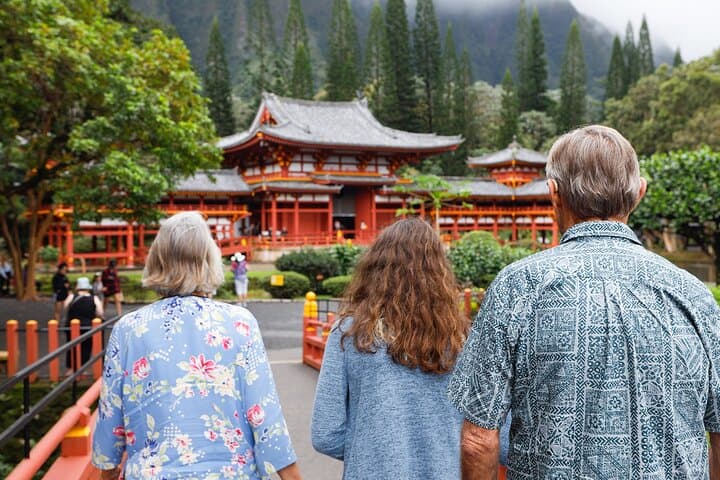
The original Byōdō-in at Uji is a UNESCO World Heritage site and appears on the Japanese ten-yen coin. Its Phoenix Hall was built in 1053, a Heian-period vision of Amida's Pure Land rendered in wood, and the Hawaiʻi version copies its plan at reduced scale: a central hall with two wing corridors and a tail corridor, symmetrical, sitting over water so the reflection completes the shape.

The figure inside is Amida Nyorai, the Buddha of Infinite Light, about eighteen feet tall, carved by Masuzo Inui and finished in gold leaf over lacquer. It is the largest figure of its kind carved outside Japan in recent centuries.

The gardens are the other half of the design. Japanese garden practice borrows the landscape beyond the boundary — shakkei — and here the borrowed landscape is a two-thousand-foot wall of Koʻolau basalt, which is a considerably more dramatic backdrop than anything at Uji. The koi ponds, the arched bridge, the raked stones and the small meditation grotto are all doing the same job of framing that cliff.

You may recognise the place from television. It has stood in for Japan in Lost, Hawaii Five-0 and Magnum P.I., among others.

Tours that visit Byodo-In

Operators run these trips past Byodo-In, or stop there as part of a longer route. We list what the booking data supports — not everything that mentions the name.

Some links below go to Viator, our booking partner. We earn a commission on bookings made through them — at no extra cost to you, and with no influence on what we recommend.

  • Oahu: Full or Half Day Grand Circle Island Tour
    Free cancellationInstant confirmation

    Plantation Tours

    Oahu: Full or Half Day Grand Circle Island Tour (opens in a new tab)

    19.5K reviews

    Choose from two exciting ways to experience Oahu's top attractions, scenic beauty, and local culture. Option 1: Dole Plantation & Haleiwa…

    6–7 hours

    Prices checked

    from $100

Near Byodo-In

Straight-line distances, so allow more on the road — the island is long and has one main parkway.

  • A wide green valley floor enclosed by steep fluted ridges under scattered cloud

    Landmark

    Kualoa Ranch

    Four thousand acres in three windward valleys, sold as a film set and older than the film industry by a very long way.

    2–6 hoursPaid, per tour. Prices vary widely between the bus tour at the low end and UTV, horseback and zipline at the high end; combination passes bundle several.6.5 mi away

  • Outrigger canoes on a lagoon in front of thatched island houses on a green Pacific island site

    Entertainment

    Polynesian Cultural Center

    Six Pacific island villages on 42 acres at Lāʻie, largely staffed by BYU–Hawaiʻi students, running midday to the night show.

    5–9 hoursPaid, and not cheap. Tiered packages: general admission, admission plus lūʻau, admission plus the evening show, and all-in options with a guided element.15.7 mi away

  • A narrow rocky headland jutting into blue ocean with a small holed islet offshore
    Free

    Viewpoint

    Lāʻie Point State Wayside

    A lithified-dune headland at the end of a Lāʻie side street, with a hole punched clean through the islet offshore.

    5–20 minutesFree. A state wayside with a handful of parking spaces and a railing.15.9 mi away

  • Rows of low spiky pineapple plants growing in red soil under open sky

    Entertainment

    Dole Plantation

    A 1950 fruit stand that became the busiest stop between Honolulu and Haleʻiwa, with a hedge maze and a Dole Whip queue.

    1–2.5 hoursGrounds, shop and food counters are free. The train, the maze and the garden tour are each ticketed, with combination tickets available.14.9 mi away

Byodo-In: common questions

Is Byodo-In Temple a real temple?

It is a real building consecrated as a temple, but not a functioning one in the ordinary sense — there is no resident monastic community and no congregation. It was dedicated in 1968 to mark a century since the first Japanese immigrants came to Hawaiʻi, and it is a scaled concrete replica of the eleventh-century Byōdō-in at Uji in Japan. It is non-denominational and welcomes visitors of every faith.

How long do you need at Byodo-In Temple?

Forty-five minutes to an hour and a half. Fifteen minutes gets you the bridge photograph and nothing else. The better visit is: ring the three-ton bell by the entrance, cross the bridge, take your shoes off and sit with the eighteen-foot Amida Buddha for a few minutes, then walk the pond loop clockwise to the grotto. The pali behind the temple is worth standing and looking at.

Do you have to pay to visit Byodo-In Temple?

Yes, there is a modest per-person admission collected at a booth on the way in, with reduced rates usually available for children and seniors. We are not quoting a figure because it has been revised more than once. Check the current rate and the closing time in the same search — the temple shuts in the afternoon, earlier than most Oʻahu attractions, and that catches out people planning it as a late stop.

Is Byodo-In Temple in a cemetery?

Yes. It sits at the back of Valley of the Temples Memorial Park, an active interdenominational cemetery above Kāneʻohe, and you drive past graves and mausoleums to reach it. Funeral processions have right of way. Keep your voice down in the car park as well as inside, do not photograph services or mourners, and leave the drone in the car. Most listings omit this entirely, and it changes how you should behave there.

How far is Byodo-In Temple from the North Shore?

About an hour and a quarter from Turtle Bay, driving south down Kamehameha Highway through Kahuku, Lāʻie and Kaʻaʻawa and past Kualoa into Kāneʻohe. It is a windward-coast stop rather than a North Shore one. The sensible way to combine them is an anticlockwise loop from Honolulu: Byodo-In first thing, Kualoa mid-morning, lunch at the Kahuku shrimp trucks, North Shore in the afternoon.