Skip to content
Search
Menu

We earn a commission if you book through this link. You pay the same price.

A waterfall dropping into a deep green pool at the head of a forested valley
Joel Bradshaw

Park

Waimea Valley

Last updated

A paved three-quarter-mile walk through botanical collections to a waterfall pool you may swim in. Life jacket required, lifeguard's call.

Photo: Joel BradshawPublic domain

Waimea Valley is the place the North Shore keeps in reserve. When the surf has closed the bay across the road, or the rain has come in off the ocean and settled, this is the one attraction on the coast that works better rather than worse. It is a botanical garden, an archaeological landscape and a cultural site in the same 1,800-odd acres, and it is owned and run by Hiʻipaka LLC, a non-profit of the Office of Hawaiian Affairs, rather than by a resort company.

The visit itself is straightforward: a paved path of roughly three-quarters of a mile runs up the valley floor from the entrance to Waihi Falls at the head of it. That path is gentle enough for a pushchair and a good deal of it is shaded. What is planted either side is the reason to walk slowly. The collections run into the thousands of taxa and are organised by region and family, with a substantial Polynesian and Hawaiian section that includes plants brought by the first voyagers rather than by nurserymen. There are named archaeological sites along the way, including a restored heiau near the entrance.

The waterfall is the part everyone comes for and the part with rules. Swimming happens only when staff judge conditions safe — the call is made each morning and can be reversed if the stream rises — and everyone who gets in wears a life jacket, which is issued free at the pool. Heavy rain upstream closes the pool regardless of what the weather is doing at the gate.

Two practical notes. There is a shuttle up and down the valley for people who would rather not walk it, which is worth asking about at the entrance if mobility is a concern. And the valley has run reduced days and a shortened weekday in recent schedules, so this is one of the few places on this coast where checking the day before you drive an hour is genuinely worth doing.

Getting there and parking

The entrance is on the inland side of Kamehameha Highway directly opposite Waimea Bay, a couple of hundred metres from the bay's beach park. Coming up the coast from Haleʻiwa it is on your right just after the bay opens up; coming down from Sunset Beach it is on your left immediately after the bridge over the Waimea River.

From Waikīkī, allow an hour via H-1, H-2 and Kamehameha Highway, plus whatever Haleʻiwa town adds on a weekend. The windward route past Kualoa and Lāʻie takes longer and is the better drive.

Parking is in the valley's own lot at the entrance, which is far more reliable than the beach park across the road. TheBus route 60 stops on the highway outside.

Swimming at Waihi Falls: the rules, and why they exist

The pool at the foot of the falls is open for swimming on most fine days, but it is a managed swim rather than a free-for-all.

  • A life jacket is required for everyone. They are provided at no charge at the pool and there is no opting out, regardless of how well you swim.
  • Lifeguards make the call each morning, and they can close the pool later in the day if conditions change. Rain in the upper valley raises the stream quickly even when it is dry at the entrance.
  • Bring a towel and wear your swimsuit under your clothes. Changing facilities are limited and the walk back is three-quarters of a mile.
  • The water is cold and fresh, not tropical. It comes off a valley with genuine rainfall behind it.

The reason the valley runs it this way is flash flooding, which is a real hazard in Hawaiian valleys and has killed people elsewhere on Oʻahu. A pool that looks placid can rise fast. If staff close the swim on the day you visit, the garden is still the garden; treat it as weather rather than as a disappointment.

What is actually planted here

Most visitors walk past the collections on the way to the falls, which is a shame, because the planting is the reason this is a botanical garden rather than a waterfall with a car park.

The valley holds several thousand plant taxa organised into themed collections — Polynesian introductions, Hawaiian natives, Ogasawara, Guam and Mariana species, heliconia and ginger, hibiscus. A significant proportion are rare or endangered in the wild, and some of the Pacific island material is held here precisely because its home range is in trouble.

The Hawaiian and Polynesian sections are the ones worth your attention if you only stop once. Kalo, ʻulu, kukui, wauke, noni, ʻawa: these are canoe plants, carried deliberately across open ocean by the people who settled these islands, and seeing them growing together makes the argument for that voyage better than any museum caption.

Cultural demonstrations, hula and craft practice run in the valley on a rotating basis rather than to a fixed timetable a visitor can plan around. Ask at the entrance what is happening on the day.

The rain day and the big-swell day

This valley earns its keep on the days the coast does not work.

When the surf is huge. Waimea Bay, Pipeline and Sunset become spectator sport rather than swimming, and there is only so long a family will stand on a shoulder watching. The valley is a hundred metres from the bay's car park and gives you a swim the ocean cannot.

When it is raining. The North Shore gets its weather in bands off the ocean; a wet morning often clears by lunchtime. A paved walk through a garden is one of the few outdoor things that is not ruined by drizzle, and the valley is greener for it. The exception is heavy rain, which closes the waterfall pool.

When you have driven up from Waikīkī and hit traffic. The valley is a self-contained two to three hours that does not depend on parking at four different beaches.

Budget two hours minimum, three if you swim and look at the plants properly. Arriving in the last hour before closing is not enough time to reach the falls and get back.

Tickets, discounts and getting up the valley

Admission is charged per person and sat in the mid-twenties for an adult around the time of writing, with lower rates for seniors, students and children, and discounts for kamaʻāina and military with ID. Children under a certain age go free. Treat every figure you read online, including this one, as indicative — verify on the day.

Buying ahead online is usually available and is worth doing on a public holiday or a big-swell weekend, when the entrance queue is real.

Getting up the valley without walking. A shuttle runs the paved road between the entrance area and the falls. Capacity is limited and it is not a scheduled service you can time a visit around, so ask at the ticket desk rather than assuming. For anyone using a wheelchair or pushing a buggy, the paved path is genuinely manageable in a way that very little else on this coast is.

What is included. Entry covers the gardens, the archaeological sites, the falls and the swim when it is open. Food and retail at the entrance are separate.
Standing on a cultural site, not a theme park

Waimea Valley was continuously inhabited for centuries and was, for much of that time, under the care of kāhuna nui — high priests — attached to the temple complex above the bay. The restored heiau near the valley entrance, the terraces and the house sites are the physical remains of that, and they are not backdrop.

What that means in practice is small and easy:

  • Stay on the paved path and the marked side trails rather than cutting between planted beds and stone features.
  • Do not climb on, sit on, or rearrange stone walls or platforms.
  • If a site is roped or signed as closed, that is a cultural decision rather than a maintenance one.
  • Leave the plants alone. A great many of them are rare, and some are the only examples in cultivation.

The valley is also connected by ridge and history to Puʻu o Mahuka Heiau on the bluff above, the largest heiau on Oʻahu. If the valley interests you, that is the natural second stop — and it is free.

Tours that visit Waimea Valley

Operators run these trips past Waimea Valley, or stop there as part of a longer route. We list what the booking data supports — not everything that mentions the name.

Some links below go to Viator, our booking partner. We earn a commission on bookings made through them — at no extra cost to you, and with no influence on what we recommend.

  • Oahu: Full or Half Day Grand Circle Island Tour
    Free cancellationInstant confirmation

    Plantation Tours

    Oahu: Full or Half Day Grand Circle Island Tour (opens in a new tab)

    19.5K reviews

    Choose from two exciting ways to experience Oahu's top attractions, scenic beauty, and local culture. Option 1: Dole Plantation & Haleiwa…

    6–7 hours

    Prices checked

    from $100
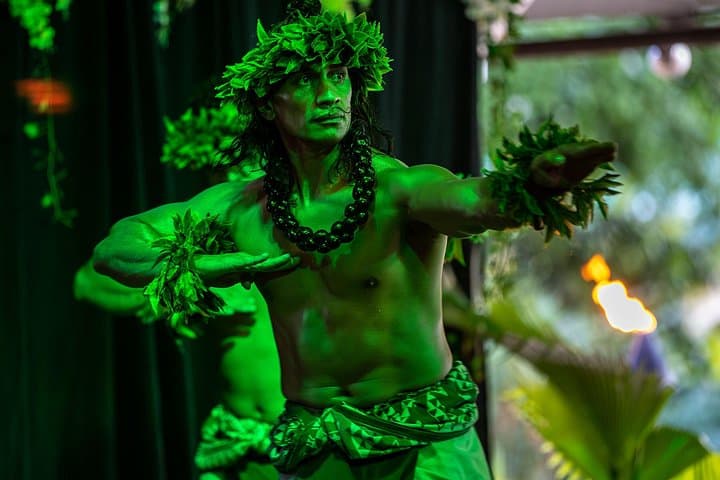
  • Roland dancing Hawaiian Kahiko
    Free cancellationLikely to sell out

    Curated Catalog

    Toa Luau at Waimea Valley, Oahu (opens in a new tab)

    3.8K reviews

    Toa Luau invites you to immerse yourself in the beauty and excitement of Polynesia on Oahu’s historic North Shore! Book any one our 3 Luau…

    3 hours

    Prices checked

    from $145

Near Waimea Valley

Straight-line distances, so allow more on the road — the island is long and has one main parkway.

  • Heavy winter surf breaking across the mouth of a bay between two lava headlands
    Free

    Beach

    Waimea Bay

    Flat enough to swim across in July, closed by thirty-foot faces in January. The North Shore's seasonal flip at its most extreme.

    1.5–5 hoursFree, including parking. The lot is small and fills early.0.5 mi away

  • The low stacked stone walls of Puʻu o Mahuka Heiau laid out on open ground above the coast
    Free

    Historic site

    Puʻu o Mahuka Heiau State Historic Site

    The largest heiau on Oʻahu, on the bluff above Waimea Bay. A sacred site that is still in use, not a lookout with a car park.

    20–45 minutesFree. There is no entrance fee and no charge to park.0.6 mi away

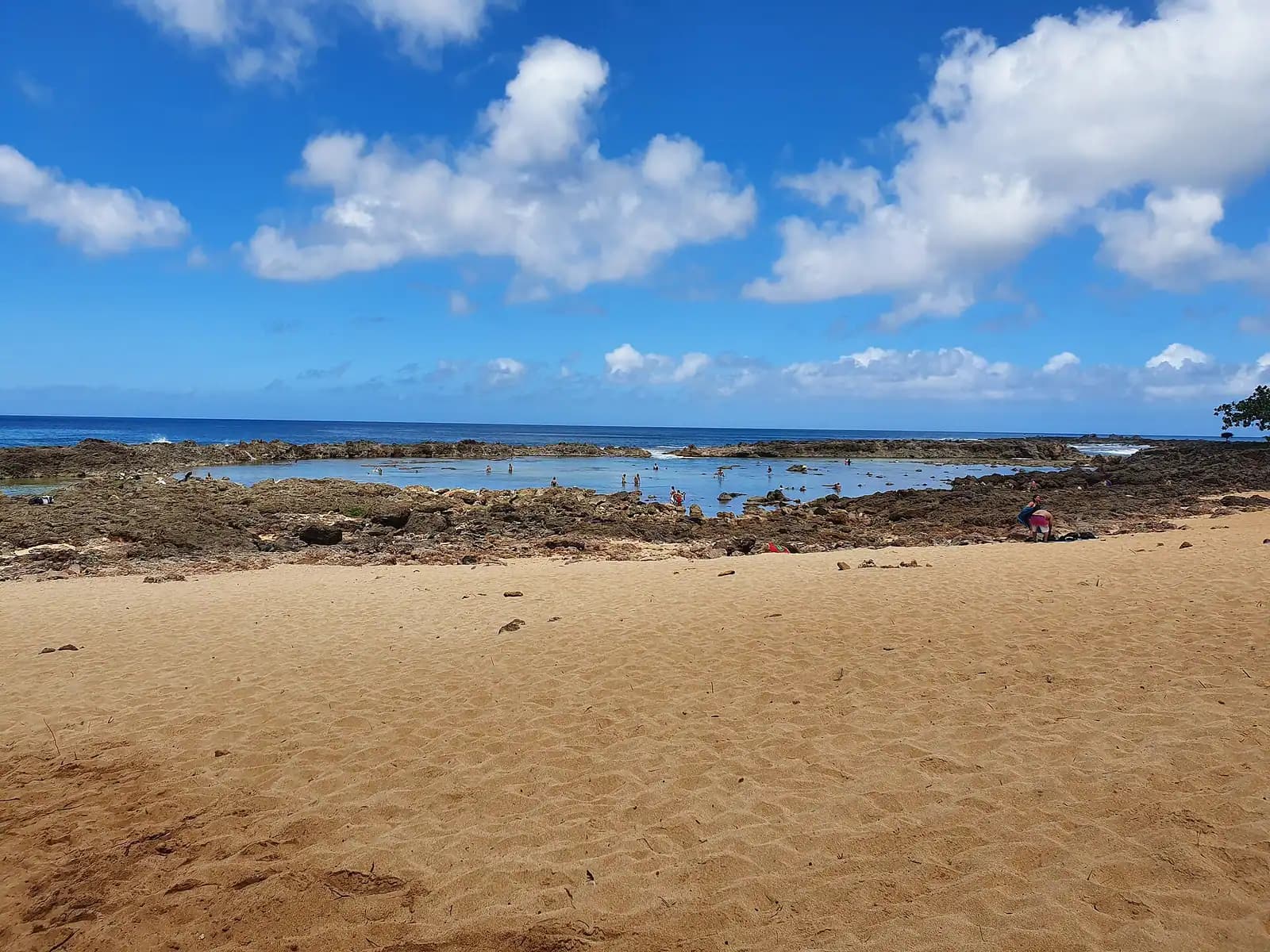
  • Flat reef slabs breaking the surface of shallow clear water off a small sand beach
    Free

    Beach

    Three Tables Beach

    Sand underfoot instead of a lava scramble, half the crowd of Shark's Cove, and three flat reef slabs that surface at low tide.

    1–3 hoursFree, with free roadside parking and no facilities.0.7 mi away

  • Reef fish moving over shallow lava structure in very clear water close to shore
    Free

    Beach

    Shark's Cove

    The best shore snorkelling on Oʻahu for four months of the year, and one of the most dangerous places on the island for the other four.

    1.5–4 hoursFree, with free parking in the beach park lot and along the highway.0.7 mi away

Waimea Valley: common questions

Can you swim at the waterfall in Waimea Valley?

Usually, but not always, and never without a life jacket. Staff assess the pool each morning and open it when conditions allow; jackets are handed out free at the water and are compulsory for everyone regardless of swimming ability. Rain in the upper valley can close the pool at short notice even when it is dry at the entrance, because the stream rises quickly. Bring a towel and wear your swimsuit under your clothes.

How much does Waimea Valley cost?

Admission is charged per person and was in the mid-twenties for an adult at the time of writing, with reduced rates for seniors, students and children and discounts for kamaʻāina and military with ID. Young children go free. Rates have been revised more than once, so check the current price before you travel. Entry covers the gardens, the archaeological sites, the walk to the falls and the swim when it is open.

How long does it take to walk to Waimea Falls?

The paved path runs roughly three-quarters of a mile from the entrance to the falls, which is about twenty to twenty-five minutes at an unhurried pace on level ground. Most people take longer because the botanical collections either side are worth stopping for. Allow two hours for the round trip with a look at the gardens, and three if you swim. A shuttle runs the valley road for anyone who would rather not walk it.

Is Waimea Valley worth it if it is raining?

It is one of the few places on the North Shore that is arguably better in rain. The path is paved, much of it is shaded, and a botanical valley in wet weather is doing what it is meant to do. The caveat is the waterfall pool, which closes when rain upstream raises the stream. If a swim is the whole reason you are going, check conditions before driving up from town.

Is Waimea Valley wheelchair accessible?

Largely, yes, which makes it unusual on this coast. The main path to the falls is paved for its entire length and the gradient is gentle. A shuttle operates on the valley road, though capacity is limited and it is not a timetabled service, so ask at the ticket desk when you arrive. The final few metres to the water's edge at the pool are uneven stone and are not step-free.